
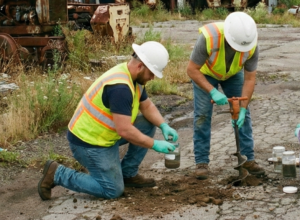
When remediation teams encounter chlorinated solvent contamination in low-permeability soils like clay, standard approaches can quickly run into challenges. Traditional dig-and-haul strategies can become costly, especially when disposal fees and trucking add up. At a former maintenance facility in the Midwest, our remediation partner faced just that — high concentrations of trichloroethene (TCE) in cohesive soils that resisted simple treatment. Rather than rely solely on excavation, the project team turned to a hybrid approach that combined in-situ chemical oxidation with targeted excavation using RemOx®S ISCO Reagent, resulting in effective treatment and reduced off-site disposal volumes.
Table of Contents
A Complex Site with TCE in Clay
The site had been used for drum storage and maintenance operations. Over time, TCE released from the building impacted soil from the surface down to 15 feet below ground. Investigation results showed highly elevated TCE levels, with some samples exceeding 15,000 mg/kg. Total impacted soil covered about 16,000 square feet, amounting to roughly 9,000 tons.
The subsurface was dominated by clay, with occasional seams of silt, sand, and gravel. These cohesive soils made uniform oxidant distribution difficult with standard injection approaches. Groundwater was not encountered, but the low permeability of the soil raised concerns about achieving effective treatment in place. Full excavation was considered, but escalating disposal costs made that option less attractive.
Evaluating Treatment Options
Before full-scale work began, the project team conducted a treatability study to evaluate potential oxidants and treatment strategies. The goal was clear: identify a solution capable of significantly reducing high TCE concentrations within the clay matrix.
Based on performance in bench testing, potassium permanganate was selected as the preferred oxidant. RemOx®S ISCO Reagent demonstrated reliable reaction kinetics and was well-suited for use in cohesive soils. This made it a strong candidate for both in-situ treatment and integration with a selective excavation strategy.
The site was divided into 46 treatment cells ranging from approximately 225 to 440 square feet each. The combined approach allowed the team to treat the majority of soil in place while minimizing the volume of material that needed to be hauled off-site.
Implementing ISCO with Soil Mixing
To ensure effective contact between RemOx® S ISCO reagent and the contaminated soil, in-situ chemical oxidation was performed using rotary drum soil mixing. A high-torque rotary mixing head was mounted on an excavator and operated at consistent speeds even when fully buried, providing uniform oxidant distribution throughout the treatment zones.
Over the course of remediation:
- Approximately 5,850 cubic yards of soil were treated in place
- A total of 218 metric tons of RemOx® S ISCO Reagent were applied
- Treatment depths reached from ground surface down to 15 feet
- Average blending rates were about 525 tons per day, with peak productivity surpassing 750 tons per day
Moisture control was critical during blending. By carefully managing water content in the soil, the team ensured proper oxidant dispersion while maintaining post-treatment soil strength. This approach eliminated the need for additional stabilizers or compaction efforts during site restoration.
To support decision-making in the field, an on-site laboratory and chemist verified treatment performance in real time. This allowed the team to adjust as needed, minimize delays, and consistently meet treatment objectives.
Results That Met Cleanup Goals
Post-treatment sampling confirmed strong reductions in TCE concentrations across the site. Shallow soils (0 to 6 feet below ground) saw TCE levels drop below 6 mg/kg, enabling those soils to be classified as non-hazardous and sent to a Subtitle D landfill. In deeper zones (6 to 15 feet), concentrations were reduced below 95 mg/kg — levels that met project objectives and allowed most soil to remain in place.
By combining ISCO with targeted excavation, the project significantly reduced the amount of material that required off-site disposal while achieving regulatory cleanup goals and returning the site to pre-construction conditions.
Why RemOx® S Made a Difference
Carus provided technical guidance throughout oxidant selection, treatment design, and field implementation with our remediation partner. On-site analytical support helped the team track progress and adjust operations quickly, keeping the project on schedule.
With a long history of producing high-quality permanganate-based oxidants tailored for environmental remediation, Carus continues to support projects where traditional methods fall short. In situations like this one — where low permeability, high contaminant concentrations, and cost constraints converge — choosing the right treatment chemistry can make all the difference in achieving an efficient, effective cleanup.
If you’d like to explore how RemOx® S ISCO Reagent could support your remediation project, our technical experts are here to help.
